

25 Feb Ferric Chloride 40% vs. 46%: How Do They Differ? A Deep Dive into the Right Concentration for Modern Industrial Profit and Efficiency
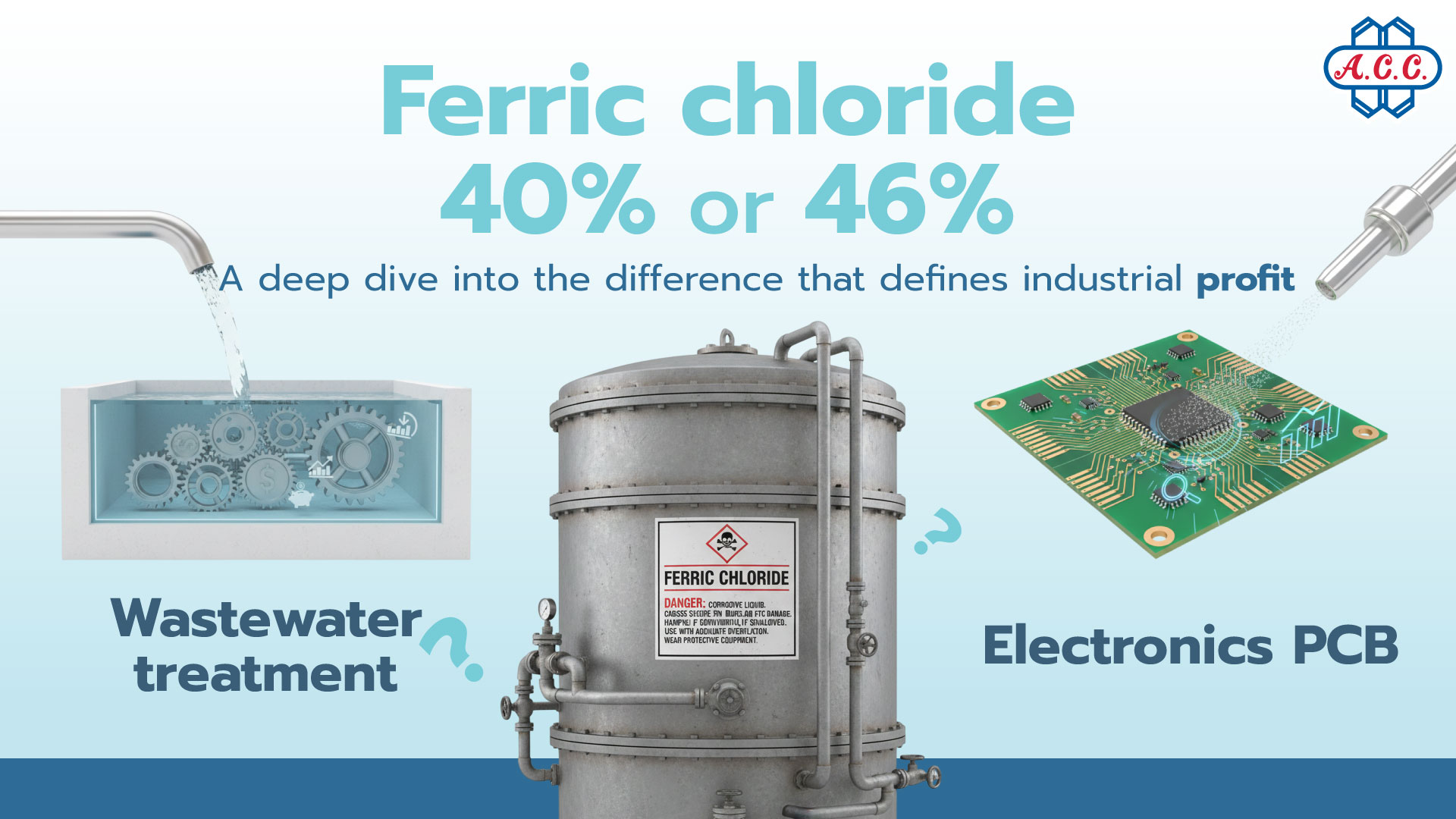
In an industrial world where every second counts as a cost and precision is the heart of the operation, choosing a basic chemical like Ferric Chloride might seem like a routine task. However, the question of whether to choose a 40% or 46% concentration remains a persistent dilemma for on-site engineers and procurement departments. This 6% difference is not merely a fluctuating figure on a quotation; it is a critical factor that determines the stability of a wastewater treatment system and the quality of the electronic circuit boards being produced.
In this article, Asian Chemical (ACC) will decode every dimension—from chemical properties and practical on-site applications to hidden cost management strategies—to ensure that every chemical lot you order is the most cost-effective investment for your organization.
Ferric Chloride: The Versatile Chemical Essential to the Industrial World
Before exploring the differences, it is important to understand what Ferric Chloride (FeCl₃) is. Chemically, it is an iron salt formed by the reaction between chlorine gas and iron, or by dissolving iron in hydrochloric acid. It generally appears as a viscous, dark brown liquid with a slightly pungent odor and highly acidic properties, making it excellent for metal etching.
Its effectiveness lies in its electrical charge. In wastewater treatment, Ferric Chloride acts as a coagulant. The positive charge of the iron neutralizes the repulsive forces of dirt particles in the water, which are typically negatively charged. This causes the impurities to clump together into small masses called flocs. Once these flocs gain enough weight, they sink to the bottom, leaving the water above clear.
On the other hand, due to its powerful and controllable corrosive properties, it is utilized in the electronic circuit board industry to etch away unwanted copper, leaving only the complex circuit patterns designed by engineers. Both roles require a concentration that is precisely right for the task—neither too much nor too little.
A Deep Dive into Ferric Chloride 40%: The Highest Standard for Wastewater Management
If you operate a food factory, a slaughterhouse, an industrial estate, or a central wastewater treatment system, a 40% concentration is the ideal solution. Why 40%? The answer lies in its cost-effectiveness and physical suitability.
-
Flocculation Efficiency
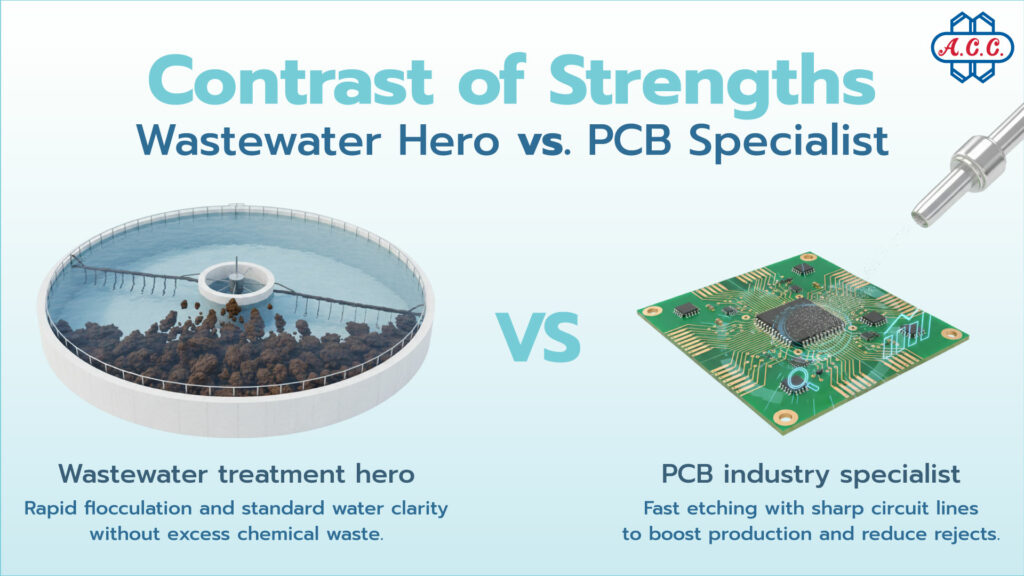
At a 40% concentration, the solution maintains a viscosity suitable for dosing pumps to move it into the treatment system. When added to water with the appropriate pH level, Ferric Chloride dissociates and forms iron hydroxide precipitates with a large mesh-like structure. This structure traps suspended solids, color, and turbidity, and most importantly, facilitates phosphorus removal and the elimination of heavy metals contaminating the effluent.
-
BOD/COD Reduction
Most factories struggle with BOD (Biochemical Oxygen Demand) and COD (Chemical Oxygen Demand) levels that exceed legal standards. Using a well-calculated amount of 40% Ferric Chloride significantly reduces these values. This lessens the load on biological treatment systems, such as aeration ponds, allowing microbes to function more efficiently and preventing settling issues or “red water” problems that often cause complications for system operators.
-
Commercial Value
In terms of unit price, a 40% concentration is usually the most balanced point for large-scale wastewater treatment. It prevents overpaying for a concentration higher than necessary for general impurity trapping. Furthermore, the substance is highly stable for storage under Thailand’s normal temperatures and does not crystallize as easily as higher concentrations.
Understanding Ferric Chloride 46%: The Heart of the Electronics and PCB Industry
Stepping up to the 46% concentration takes us beyond water purification and into the realm of industrial innovation. The Printed Circuit Board (PCB) industry and metal mold production are the primary users of this specification.
-
Etching Rate
In circuit board production, the goal is to etch away excess copper as quickly as possible while maintaining line precision. The 46% concentration has a denser iron charge, resulting in a more intense and rapid chemical reaction. This significantly boosts production line capacity. Faster etching also reduces heat generation and limits the exposure of other materials to the chemical, resulting in fine, sharp circuit lines without blurring or breakage.
-
Etchant Quality Control
High-concentration solutions like 46% often come with stricter purity standards. In electronics, even minor impurities can affect conductivity or damage the circuit. Choosing high-quality 46% Ferric Chloride from a trusted manufacturer like ACC guarantees that products will not be rejected due to substandard circuit patterns.
-
Other Specialized Applications
Beyond PCBs, 46% Ferric Chloride is used in surface treatment processes before plating and as a catalyst in certain chemical industries that require anhydrous conditions or minimal water content in the reaction system.
Technical Differences Beyond the 6% Figure
It might be tempting to think that if 40% is insufficient, one can simply add more to equal 46%, or dilute 46% with water to get 40%. While theoretically possible, there are distinct technical details in industrial practice:
-
Viscosity
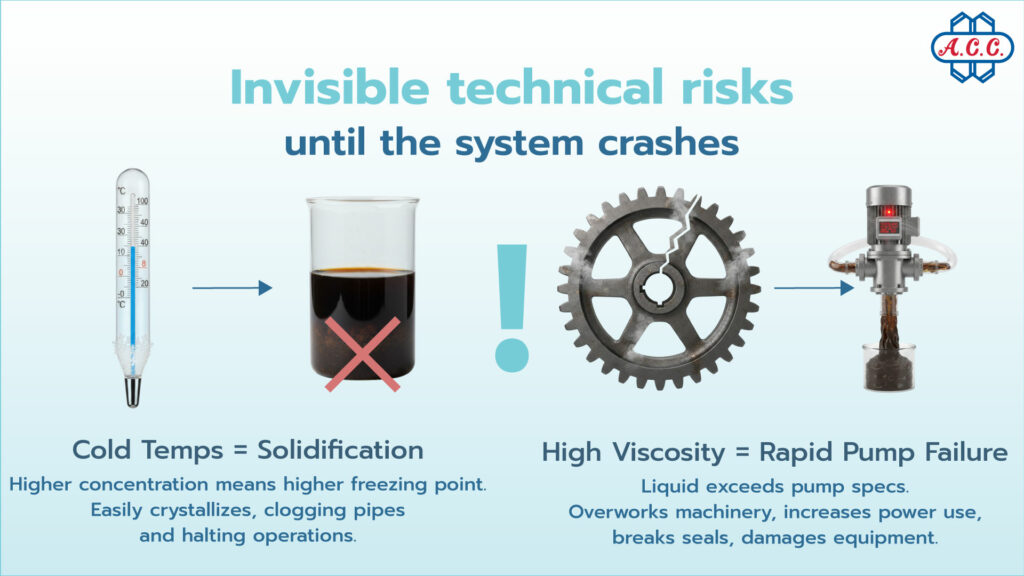
46% Ferric Chloride is significantly more viscous than 40%. If your dosing pump system is designed for standard solutions, using 46% may cause the pump to work harder, leading to heat buildup and potentially shortening the lifespan of rubber seals or spare parts.
-
Crystallization Point
This is a crucial factor. Higher concentrations are more prone to crystallization as temperatures drop. Storing 46% in cool areas or during winter may result in crystals forming at the bottom of the tank. these crystals can clog delivery pipes and cause system downtime. In contrast, the 40% specification is more stable in this regard.
-
Specific Gravity
Differences in density affect precise dosing calculations. If on-site staff measure by volume (liters) without understanding the difference in specific gravity, it can lead to incorrect chemical dosing, causing effluent to miss standards or resulting in unnecessary chemical waste.
The Consequences of Choosing the Wrong Specification
Choosing the wrong specification involves more than just a difference in purchase price; it creates hidden costs that can impact the operation later.
-
Using 46% for General Wastewater Treatment
While it might settle flocs slightly faster, you are overpaying for a concentration that is not being fully utilized. In addition to the higher chemical price, the increased corrosivity accelerates the wear and tear of storage tanks, pipes, and valves, necessitating frequent maintenance.
-
Using 40% for PCB or Circuit Etching
The etching process will be significantly slower. The resulting copper patterns may suffer from undercutting because the solution lacks sufficient corrosive power. This leads to substandard output and product rejects in the production line, the cost of which is far higher than the price difference between the chemical grades.
5-Point Checklist Before Purchasing Ferric Chloride
To ensure a 100% correct purchasing decision, consider these questions:
- What is the primary objective? (For wastewater treatment, choose 40%. For circuit etching, choose 46%.)
- Are the machinery and equipment compatible? (Check pump specifications and tank materials for resistance to corrosivity and viscosity levels.)
- What is the monthly consumption volume? (For massive volumes in wastewater treatment, 40% usually helps save the annual budget more effectively.)
- How important is quality consistency? (Chemicals from non-standard manufacturers may have fluctuating concentrations, making system control difficult. Choose a supplier with a Certificate of Analysis for every lot.)
- What about after-sales service and technical consultation? (You need a supplier who doesn’t just sell the product but can also assist with jar testing or system adjustments when problems arise.)
Standards and Safety: Why Ferric Chloride from ACC?
At Asian Chemical Co., Ltd. (ACC), we understand that every liter of Ferric Chloride impacts your business success. Therefore, we produce and distribute Ferric Chloride that undergoes the most rigorous screening and quality control processes.
Why does the world trust us?
-
Over 50 Years of Experience
We are not just a seller; we are a manufacturer with deep expertise, truly understanding the nature of chemicals and their applications in the industry.
-
Comprehensive International Standards
We are among the few certified for ISO 9001 (Quality), ISO 14001 (Environment), ISO 45001 (Occupational Health and Safety), and ISO/IEC 17025 for laboratories. This ensures that every liter delivered to you meets the exact specification and purity standards.
-
Sustainability and Safety
We prioritize safe transportation with specially maintained vehicles and modern storage systems to prevent environmental impact, following the CH2E model we uphold.
Conclusion
Ultimately, whether it is 40% Ferric Chloride—the hero of the wastewater treatment pond—or 46% Ferric Chloride—the star of the electronics factory—choosing the right one for the job is the key to industrial chemical management.
Investing in high-quality chemicals from a reliable manufacturer may seem slightly more expensive initially, but when measured by production stability, consistent wastewater quality, and the lifespan of your machinery, you will find that this is the most sustainable way to significantly reduce costs for your company.
If you require further advice on using Ferric Chloride, you can contact the expert team from Asian Chemical Co., Ltd. (ACC) through the contact channels below. We are ready to be the partner that walks alongside your industrial success.
📞 Tel: +66 (38) 570 150-2 Ext. 106, 107 or +66 (81) 8337 043
📩 E-mail: [email protected]
🌐 Website: https://acc1976.com/th/
🏢 Asian Chemical Co., Ltd.
85/1 Moo 5, Wellgrow Industrial Estate, Bangna-Trad Rd. Km.36, Bang Samak, Bang Pakong, Chachoengsao 24130
No Comments